
1. What We Know So Far About the Oil Spill near the LOOP
The recent oil spill near the Louisiana Offshore Oil Port (LOOP) has raised concerns across the Gulf Coast fishing industry. Commercial fishermen, shrimpers, crabbers, oysterman, and charter captains may experience financial losses when an oil spill disrupts fishing operations.
Preliminary reports indicate that the oil spill occurred on or about February 26, 2026, during a crude oil transfer operation associated with the Louisiana Offshore Oil Port (LOOP) located approximately 18 miles offshore of Grand Isle and Port Fourchon, Louisiana in the Gulf. Early estimates from responding agencies suggest that an estimated 31,500 gallons were released into Gulf waters after a mechanical failure involving a cargo transfer hose connected to the LOOP offshore system. The spill occurred while crude oil was being transferred between offshore infrastructure and a tanker vessel. The incident triggered a coordinated response by the United States Coast Guard, the Louisiana Oil Spill Coordinator’s Office (LOSCO), and LOOP personnel, who formed a Unified Command to oversee containment, recovery, and environmental monitoring efforts.
While cleanup operations that included responders, multiple vessels, aerial surveillance aircraft, and thousands of feet of containment boom were deployed to capture oil on the water’s surface, oil has been sighted on Terrebonne Parishes barrier islands and waterways. Authorities continue to investigate the cause of the failure and the full extent of the oil spill, and additional information may emerge as the investigation progresses. The LOOP oil spill near Port Fourchon and Grand Isle may affect fisherman throughout Terrebonne Parish, Lafourche Parish, and nearby Gulf fishing grounds.
If you feel you may have a claim, contact us today for a FREE consultation by calling 985-868-4800, emailing Claims@BroussardDoveLaw.com or filling out a form at https://broussarddovelaw.com/contact-us/
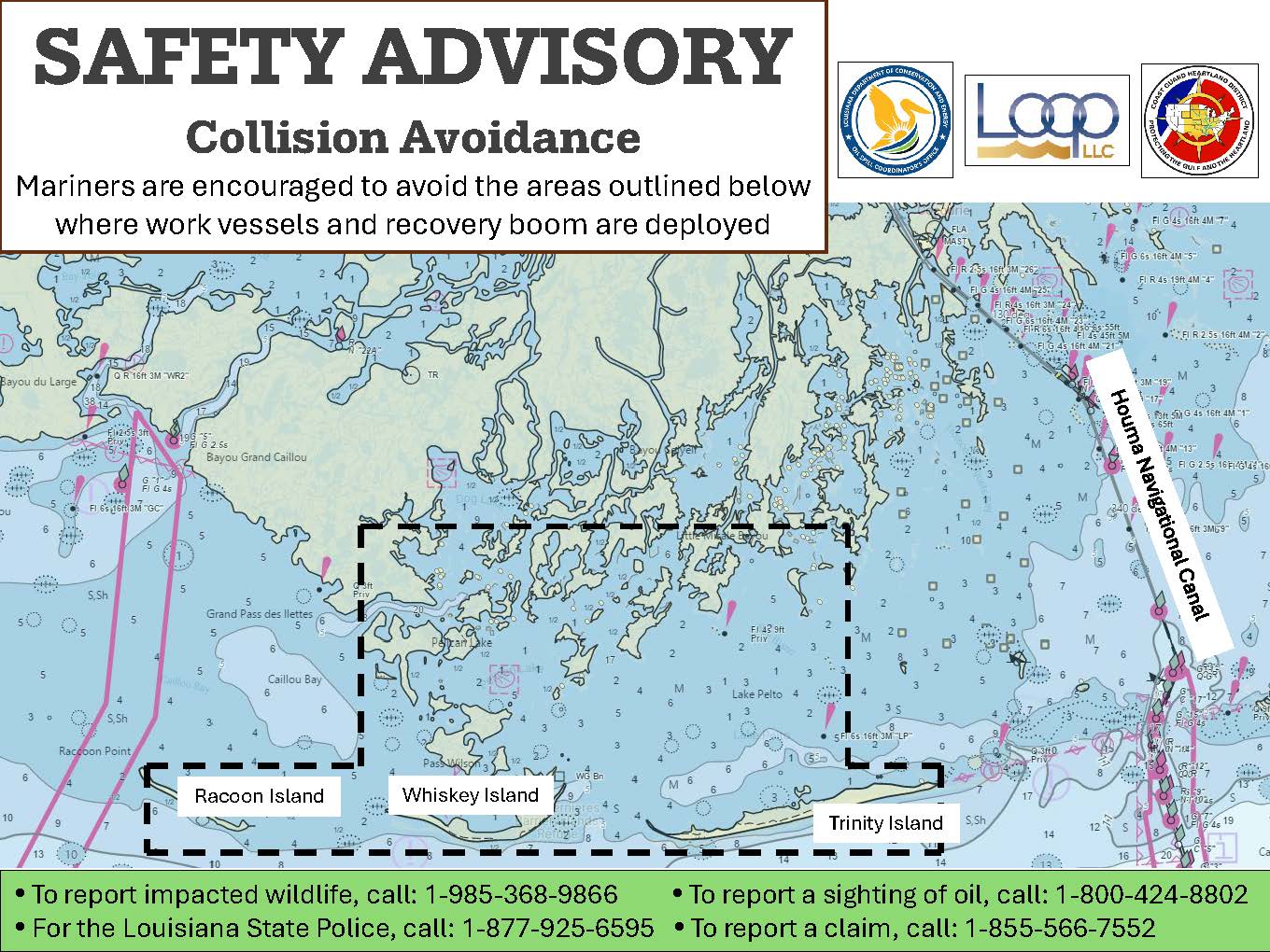
2. What Areas of the Gulf Could be Affected?
Currently, the Coast Guard has issued the following mariner advisory:
3. How Louisiana Commercial Fishermen Can File Claims After the Oil Spill
Under federal law, fishermen who suffer economic losses due to an oil spill may be entitled to compensation. The primary law governing these claims is the Oil Pollution Act of 1990 (OPA). This law allows fishermen and seafood businesses to recover damages when their income is affected by contamination, fishing closures, or disruption of marine life.
Importantly, fishermen do not need to prove that oil physically touched their boat or gear in order to recover losses. If the spill affects your ability to fish or sell seafood, you may have a valid claim.
Steps commercial fishermen should take right now include:
- Document lost fishing trips and reduced catches
- Keep records of seafood sales and cancelled orders
- Save fuel receipts showing increased travel to new fishing grounds
- Take photos of oil or contamination if observed
- Keep trip tickets, catch logs, and tax records showing prior fishing income
These records can help demonstrate the financial impact of the spill when submitting a claim. Many fishermen choose to work with an attorney to help gather documentation and pursue compensation from the responsible parties.
Under Oil Pollution Act of 1990 (OPA), responsible parties can be held liable for economic damages suffered by fishermen and coastal businesses. You must first report a claim to the responsible party who has 90 days to respond prior to filing a lawsuit.
Recoverable damages may include:
- Lost fishing income
- Reduced seafood harvests
- Cancelled charter trips
- Damage to fishing equipment
- Business interruption losses
4. What the Oil Spill Could Mean for Louisiana Shrimp Season
Louisiana shrimpers rely on the health of the Gulf ecosystem to produce strong shrimp seasons. Even relatively small oil spills can disrupt the delicate lifecycle of shrimp populations, especially the brown shrimp larvae that grow on the surface mixed with the oil spill.
Shrimp depend on clean coastal waters and estuaries for breeding and development. Oil contamination can affect shrimp larvae and eggs, potentially reducing or contaminating shrimp populations later in the season.
Shrimpers may also experience economic losses due to:
- Fishing ground closures
- Reduced shrimp harvests
- Lower seafood market demand
- Increased fuel costs to find productive fishing areas
- Damage to nets or gear exposed to oil contamination
Even when oil remains offshore, it can affect water quality and marine ecosystems that shrimp depend on. Because shrimping is highly seasonal, disruptions during key periods of the year can create serious financial hardship for shrimpers and their crews.
Shrimpers who notice changes in catch levels or fishing conditions should begin documenting these impacts as soon as possible.
5. Impact on Louisiana Crabbers
The LOOP oil spill could also impact Louisiana’s commercial crabbing industry. Blue crabs depend on healthy estuaries, marshes, and nearshore Gulf waters to feed and grow. Oil contamination in these areas can affect crab habitats and the bait sources crabbers rely on. Even if oil does not directly contact crab traps, spills can disrupt crab movement patterns, reduce crab populations, or force fishermen to relocate their traps to other areas. Crabbers may also suffer economic losses if buyers reduce purchases due to contamination concerns or if fishing areas are temporarily restricted. Because crabbing is highly dependent on consistent harvests, even short disruptions can significantly affect a crabber’s income and operating costs.
6. Impact on Louisiana Oysterman
Oyster harvesters may be particularly vulnerable to the effects of an oil spill because oysters grow in fixed reef locations and cannot move away from contaminated waters. If oil reaches oyster reefs, marshes, or coastal bays, it can lead to oyster bed closures, contamination concerns, and long-term damage to oyster habitats. Even the risk of contamination can cause state regulators or seafood markets to temporarily halt oyster harvesting or sales. For oyster lease holders and harvesters, this can mean lost harvest seasons, reduced oyster production, and financial losses for both fishermen and the seafood businesses that rely on oyster supplies. Because oyster reefs take years to develop and recover, environmental impacts from an oil spill can potentially affect oyster production for multiple seasons.
7. Impact on Charter Captains
Charter fishing captains may also experience economic losses as a result of the oil spill near the LOOP. Charter operations depend heavily on healthy offshore fishing conditions and strong tourism demand. Even the perception of oil contamination in the Gulf can lead to cancelled fishing trips, reduced bookings, and fewer tourists willing to schedule offshore charters. If fishing grounds are disrupted or fish migrate away from affected areas, charter captains may also have difficulty locating fish for their clients, which can further impact their business reputation and future bookings. Because many charter operators rely on seasonal tourism and advance reservations, even short-term disruptions can result in significant lost income for captains, deckhands, and the coastal businesses that support the charter fishing industry.
Fishermen and seafood businesses affected by the spill may have the right to pursue compensation for these losses.
BROUSSARD | DOVE is an experienced maritime and oil spill litigation law firm who can help fishermen understand their legal options and pursue recovery to maximize damages related to the oil spill. For more information visit https://broussarddovelaw.com/oil-spill-damage/
If you feel you may have a claim, contact us today for a FREE consultation by calling 985-868-4800, emailing Claims@BroussardDoveLaw.com or filling out a form at https://broussarddovelaw.com/contact-us/
If we do not recover and money, we do not charge a fee!
Author’s Information:
Sye J. Broussard, J.D., M.B.A.
Managing Partner
BROUSSARD | DOVE
Sye J. Broussard – Broussard Dove
Louisiana Oil Spill Lawyer
About the Author:
Prior to the 2010 BP Oil Spill, Sye’s research paper on the Oil Pollution Act of 1990 was published in the Loyola Maritime Journal and was cited and utilized by lawyers, journals, articles, research papers, court pleadings, legislators, and attorney general’s offices throughout the country to argue lawsuits and draft legislation in response to the BP Oil Spill. As an attorney on the BP Oil Spill, Sye successfully recovered $MILLIONS$ of dollars for commercial fisherman, offshore workers, businesses, and property owners.
DISCLAIMER: The information provided above and on our website does not, and is not intended to, constitute advice. The information provided is for general informational purposes only and may not constitute the most up to date legal or other information. Any links to third party websites are only for the convenience of the reader. Broussard | Dove makes no representation or warranty as to the accuracy of the third party website information. Readers of this website should contact their attorney to obtain advice with respect to any particular legal matter. No reader, user, or browser of this site should act or refrain from acting on the basis of information on this site without first seeking legal advice from counsel in the relevant jurisdiction. Only your individual attorney can provide assurances that the information contained herein – and your interpretation of it – is applicable or appropriate to your particular situation. Use of, and access to, this website or any of the links or resources contained within the site do not create an attorney-client relationship between the reader, user, or browser and website authors, contributors, contributing law firms, or committee members and their respective employers.